
Chess of the Hidden Gates
Creator quick guide
Why it works on stream: Every card is a chess move, and enemies telegraph their next step right on the board. Chat can call the play before each commitment, making every turn a shared puzzle with clippable comeback swings.
Demo scope: A free vertical slice featuring the Horse Master, a complete Act I run, and a climactic boss encounter.
Beats worth showing
- Deckbuilding between fights — build and upgrade one focused deck.
- Chess-movement combat — movement cards follow Chinese-chess piece rules, while attacks have range and shape.
- Telegraphed intent — enemies preview the exact tile they will hit, so positioning is your defense.
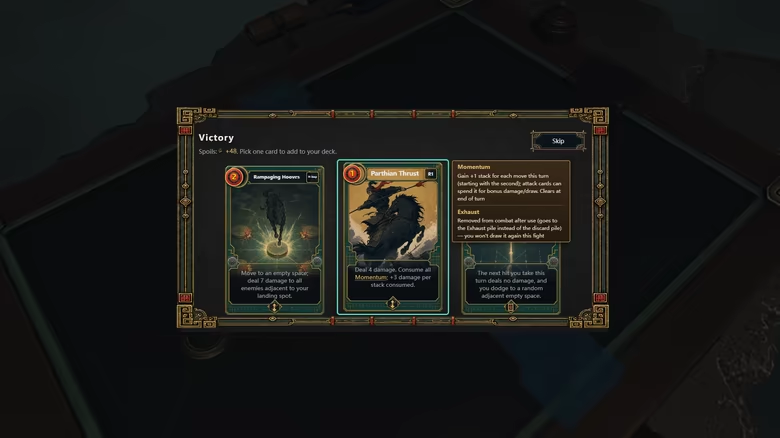
- Horse Master momentum — chain movement cards, build Momentum, and turn precise positioning into a burst turn.
- Boss fight — the demo ends with a nine-star boss for a clean climax clip.
Creator notes: Full monetization is welcome. There is no spoilers embargo on the demo. Playable in English plus 9 other languages. Press kit · Steam wishlist
One deck. One board. An endgame that has waited three thousand years to be finished.
Chess of the Hidden Gates fuses roguelike deckbuilding with the footwork of Chinese chess — every card in your hand is a move, and every move decides who gets taken.
Beyond numbers: position
This is no stand-and-trade card game. A beast’s blade falls on a square, not on your health bar — step aside and the hit means nothing; stand wrong and you’re surrounded. Read the board, bait your enemies, force the position you want. It isn’t about playing stronger cards. It’s about playing better chess.

Three pieces, three ways to play
-
Horse Master — chained leaps that build Momentum, spent in one explosive strike.
-
Pawn Commander — ground held is armor gained: stand Steadfast, unmoved as a mountain.
-
Cannon Adept — strike through a screening piece with Relay shots that cross the whole board.
The world is a board; all things are pieces
The battle of Zhuolu never ended — its endgame lies locked behind the Eight Gates. You are the last player, entering with a single deck: every card moves your piece. The knight leaps, the cannon strikes through a screen, the pawn crosses the river and never turns back. Your deck is your footwork; your footwork is your life.
What’s on the board
-
125 cards across four rarities — each one a move, a kill, or a trap.
-
Three classes, three signature systems: Momentum burst, Steadfast defense, Relay artillery.
-
Thirty-odd beasts, each with a backstory, a temper, and a mechanic of its own.
-
Nine Star bosses across three acts, every one rewriting the rules — up to Chiyou’s final reckoning.
-
Reshuffled every run: terrain, threats, beasts, drops. No two runs inside the Eight Gates are alike.
-
A living bestiary: defeat a beast to unlock its legend, told in the voice of an old field journal.
Every enemy is a prisoner
The beasts of these mountains aren’t health bars — they’re captives of the thousand-year board. The wolves are the grudges of Zhuolu’s fallen soldiers; the foxes, a corrupted line of the sacred Qingqiu; the tree that blocks your path was planted to seal this prison and has guarded its gate ever since. Thirty-odd creatures, each with a history and a temper that forces you to read the board. Beyond the last gate, the Nine Stars rotate every run — a false healer who mends every lesser beast, a fire-star that burns the whole board through, and Tianfu, the fallen sage, who turns your own class’s cards against you. Fight to the end, and the remnant soul of Chiyou awaits — and your choice.
One table, one duel
The whole war fits on a single scholar’s desk — a lacquered board for a battlefield, carved figurines for pieces, incense smoke and candlelight pooling at the board’s edge. You lean over it the way you’d lean over a real game: a three-thousand-year endgame, taken up again under your hand.